Words: Khumoetsile Seamogano
Images: Girl Gone Authentic fieldnotes,
and archival material including: Akha People:
Tim Daper, Karen People: Jorgen Bisch, 1962,
Lahu People: Eric Lafforgue
What I recognised in the mountains of Northern Thailand.
Years before I found myself in the mountains of Northern Thailand, I had grown up in the Kalahari among people whose knowledge of the land was woven into everyday life. Plants had names and uses. Animals carried stories. Materials became objects. Healing, spirituality, food and community were not neatly separated into categories.
So when I arrived in Chiang Mai, something felt strangely familiar.
The people I encountered in the mountains surrounding the city belonged to different communities, with different languages, histories, traditions and relationships to place. The Akha were not the Karen. The Karen were not the Hmong. The Mien were not the Lisu or the Lahu. They had arrived in the region through different histories of migration and displacement, carrying their own worlds with them.
The mountains around Chiang Mai were not simply scenery. They were farms, forests, sources of food and materials, places of memory, spiritual landscapes and homes. Knowledge lived in clothing, agriculture, ritual, architecture, adornment and the hands that made things.
I had seen this before.
Just not here.
Six Peoples. Six Histories
The term “hill tribe” has long been used in Thailand to describe highland communities, although it is increasingly recognised as an imprecise and sometimes derogatory category. The people grouped under it are not one people, but distinct communities with their own languages, histories and cultural traditions.
Among the communities traditionally associated with Thailand’s northern highlands are the Akha, Mien, Karen, Hmong, Lisu and Lahu. Many have histories of migration across what are now the borders of China, Myanmar, Laos and Thailand. Though the borders are relatively recent, the mountains are not. Let’s get into it. Who are these people of the Golden Triangle?
The Akha: Silver Crowned Children of the Hills
The Akha are a highland people whose communities today extend across China, Myanmar, Laos, Thailand and Vietnam. Their historical homeland is generally associated with the mountainous regions of southern China, particularly Yunnan, from where communities moved southward over generations.
Their story is therefore, in part, a story of migration.
Long before modern borders divided the mountains into separate countries, people were moving through these landscapes, establishing villages, cultivating hillsides and carrying languages, beliefs, agricultural knowledge and customs with them.
The Akha who live in Thailand are part of this much larger cultural world. Their history has also been shaped by the pressures that accompany changing borders and political systems: displacement, state policies, missionary activity, war, economic change and the gradual transformation of highland life.
Yet culture travels in ways that borders cannot easily contain.
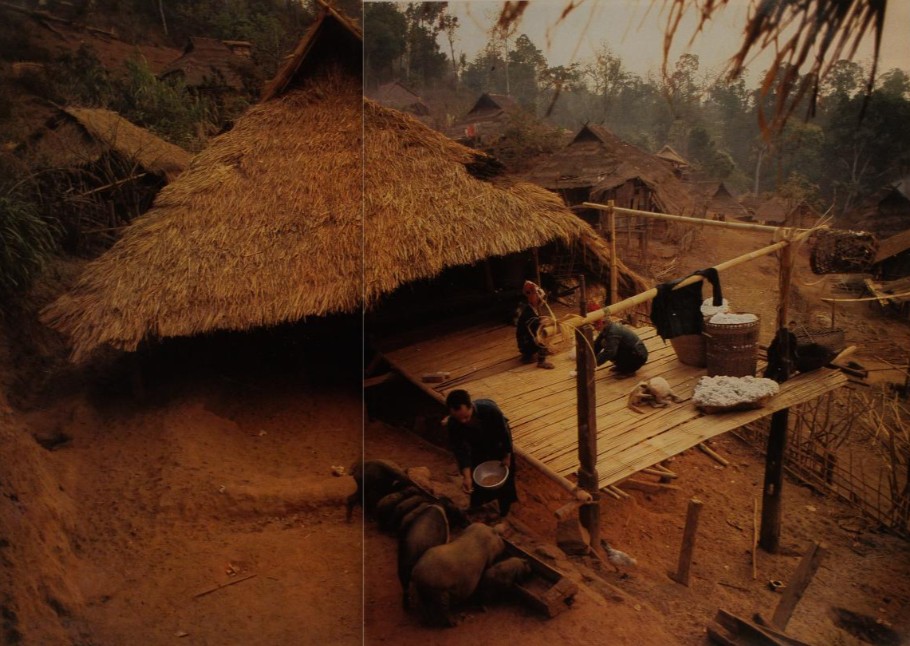
Traditional Akha house bult from bamboo and thatch. The women spin cotton, as the man feeds the pigs.
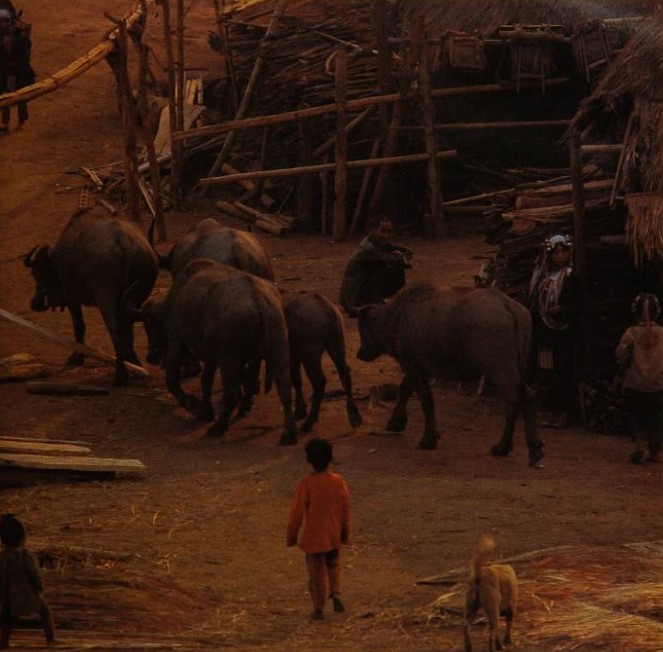
The Akha people keep buffalo for work in the fields.
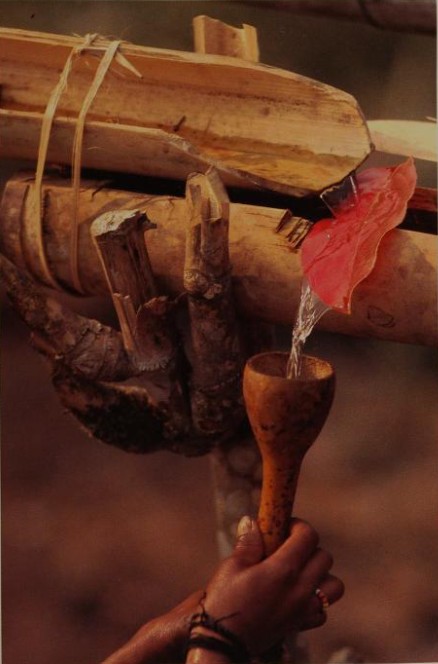
A leaf temporarily placed at the meeting mouth of the pipe directs water into a jug.
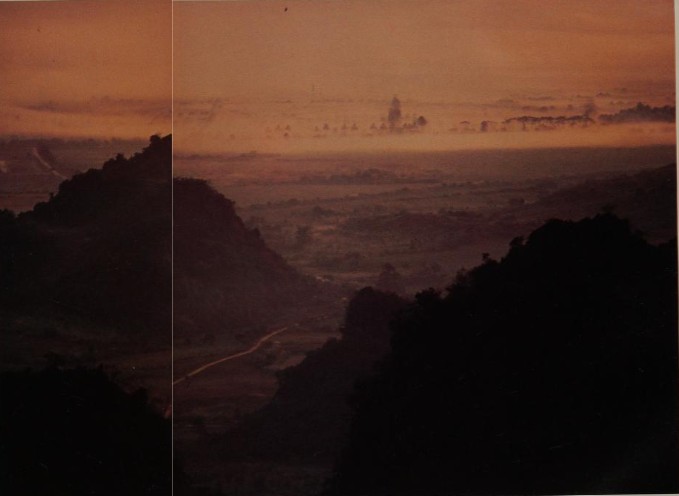
Early morning view of the lowlands, a city of highrises and highways from the hillside.
The Headdress
Known as the u-coe, the Akha headdress is perhaps the first thing one notices.
There is no single Akha headdress. Different Akha communities have developed distinct forms, and the shape and arrangement of ornaments can communicate subgroup or clan identity. The Ulo Akha headdress from northern Thailand, for example, may combine woven grass fibre with Job’s tears seeds, dyed rooster feathers, fur and old coins.
Let us consider the materials for a moment.
A seed carries something of the landscape. A feather carries the animal world. Fibre records the plants from which the foundation was made, and the hands that transformed them. A coin has travelled. Before landing on the headdress, it may have passed through other hands, markets and places. It belongs to an economic world beyond the village, and yet here it becomes part of something intensely personal. The headdress gathers these different worlds together and unlike an object placed safely inside a cabinet, it is worn on the body.
A woman may continue adding ornaments to her headdress over the course of her life. Over time, it tells a story that belongs to its wearer alone. Each addition becomes an intimate tapestry of the life story of a woman and her headdress.
Historically, elaborate headdresses were worn as part of everyday dress. Today, many are more commonly reserved for ceremonies and special occasions.
That shift raises a difficult question. What happens when an object moves from everyday life into the realm of ceremony? Does it become heritage? Costume? Symbol? Performance? Or, does it continue to carry meanings that are simply less visible to those looking from outside?
Perhaps the answer depends on who is looking.
To a visitor, the headdress can appear extravagant, colourful, even picturesque. It is easy to photograph it as evidence of an ancient tradition and leave it there.
But an object becomes more interesting when we stop asking whether it looks traditional and begin asking what work it does.
What does it remember?
What does it communicate?
What does it allow its wearer to carry foward?
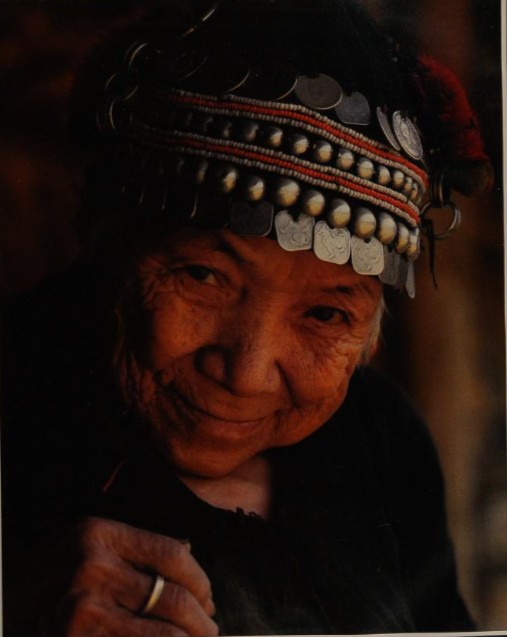
Akha elder.
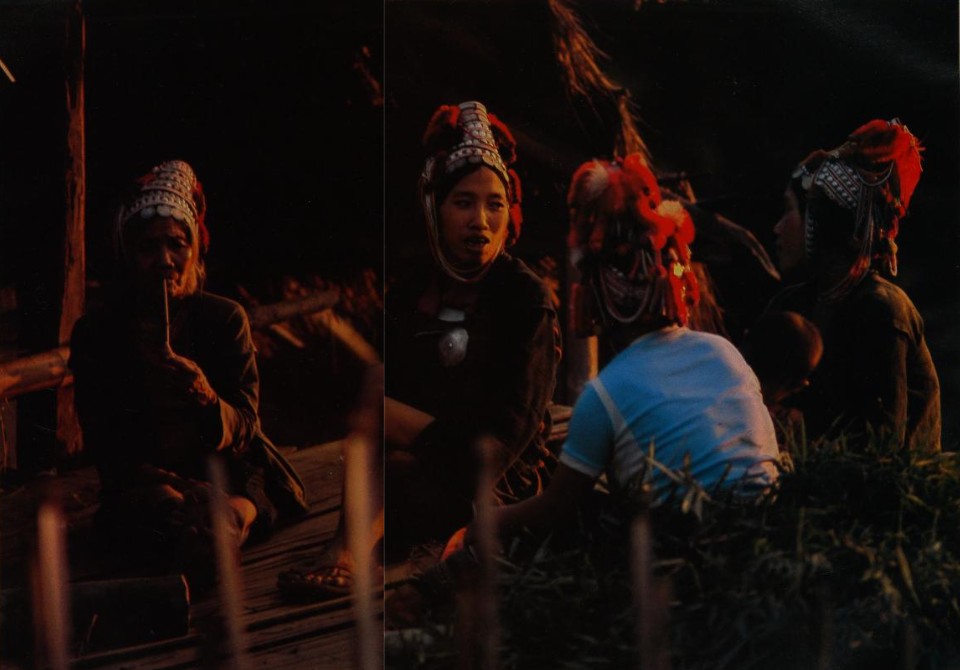
Older women gathering after a long day.
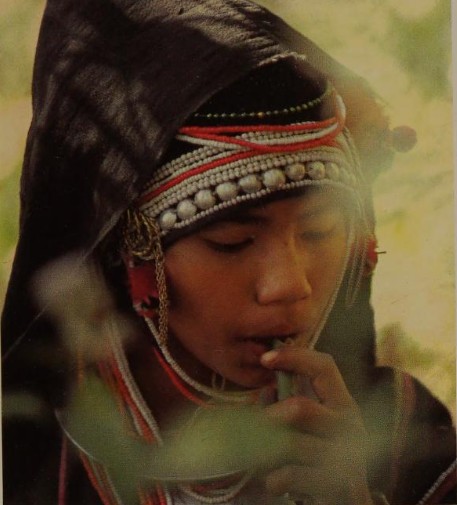
Akha girl testing a pipe she just made.
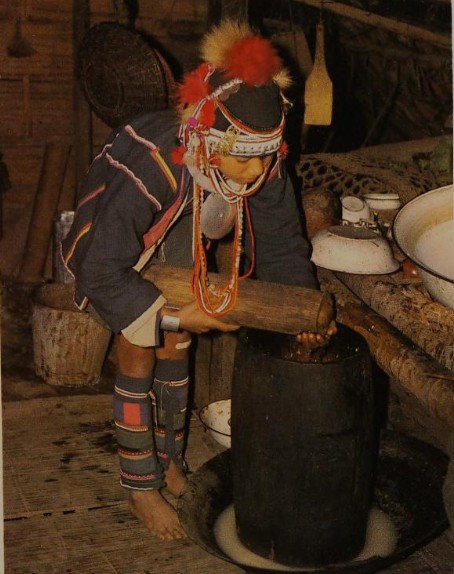
Akha girl pours water from a bamboo container into a rice steamer.
The Land
The hills are not simply where the Akha live. They are the landscape from which an entire body of knowledge was developed.
For generations, Akha communities practised forms of swidden agriculture, cultivating different areas of the forest in rotation. A plot might be cleared and cultivated for a limited period before being left to regenerate while cultivation moved elsewhere. When enough land and time were available, the cycle could continue: the forest recovered, and the farmer eventually returned.
It was not an agricultural system designed for permanence, rather it was a system designed for movement. The forests on which the system depended have been reduced by logging, development and the expansion of other forms of land use. At the same time, population growth has increased pressure on the remaining agricultural land. In many places, the intervals in which fields can be left to recover have become shorter.
The problem is therefore not simply that the Akha are abandoning an old way of farming. The conditions that allowed that knowledge to work are being altered around them. A farmer can possess generations of knowledge about when to clear, when to plant, when to leave a field fallow and what the forest will become in the years that follow. But, knowledge is difficult to preserve when the landscape in which it was developed is no longer available to practice it.
And this is the quieter tragedy of environmental change.
We often speak about the loss of forests as a loss of trees, but it also be a loss of knowledge. When a forest disappears, the knowledge of what grows there, what can be gathered, what can be cultivated, what should be left alone and when a field will recover can disappear with it.
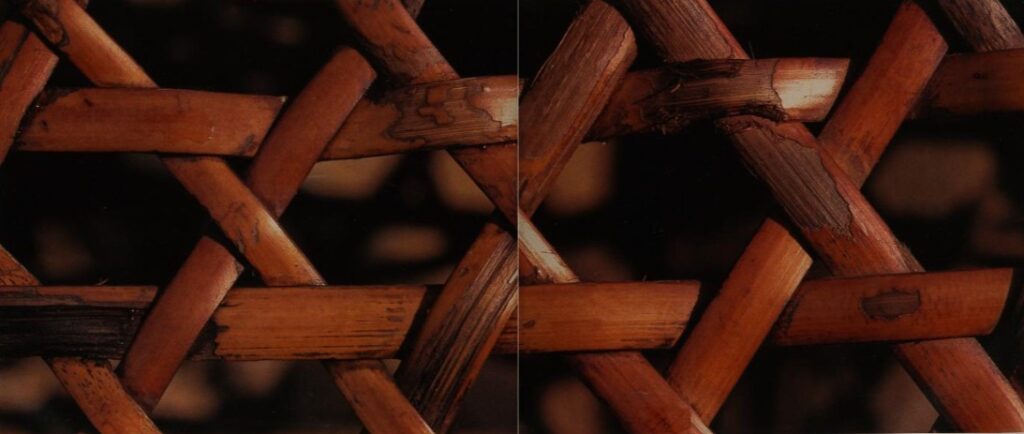
The Akha are skilled at shaping bamboo.
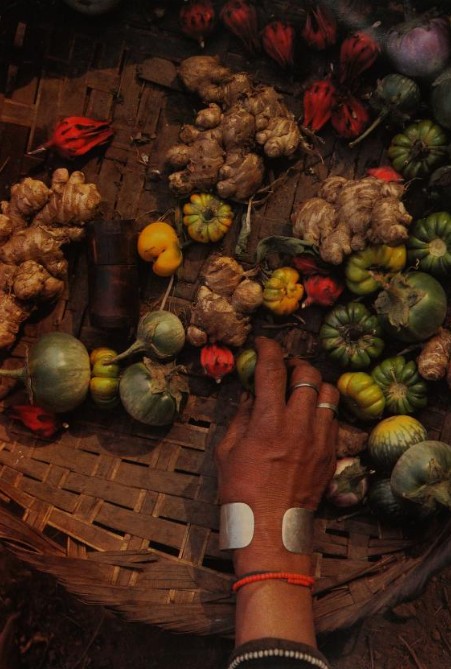
A woman places freshly harvested tomatoes on a tray that holds other produce: ginger, mauve and green auberfines, roselle.
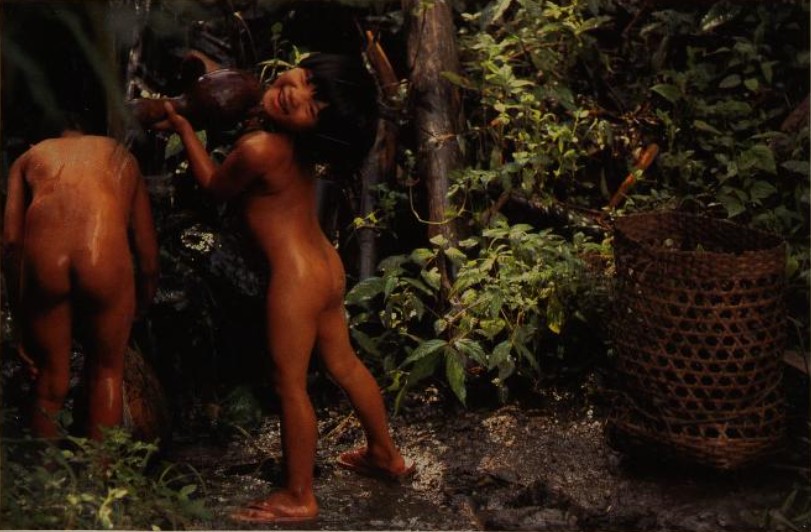
Children bathing at a local stream before carrying their baskets home.
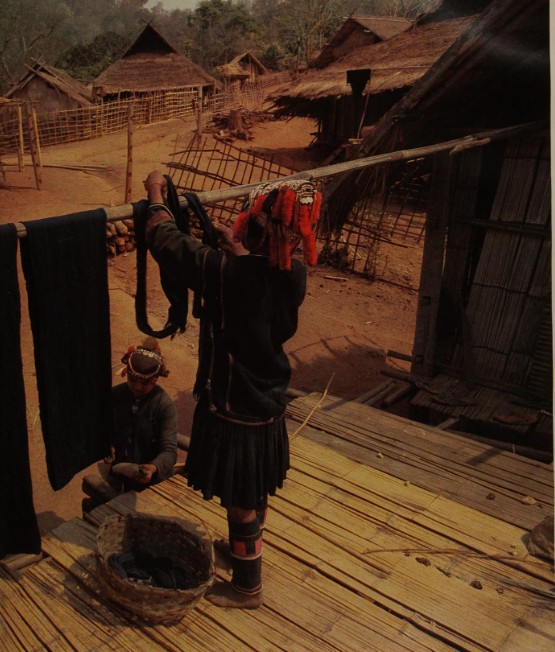
Akha woman hanging up indigo dyed cloth.
The Akha have, of course, adapted before. Their culture is not a fossil. Crops, techniques and ideas have travelled between communities and across borders for generations. There is nothing inherently contradictory about adaptation. When governments restrict traditional forms of cultivation, when forests are logged, when roads and development alter access to land, and when communities are encouraged toward permanent agriculture and cash crops, adaptation is no longer occurring entirely on their own terms.
How then do The Akha people carry forward traditions and knowledge of a world that is disappearing?
Images: Grunfeld, Frederic V. Wayfarers of the Thai Forest: The Akha. Photographs by Michael Freeman. Time-Life Books, 1982.
The Mien (Yao) People
The Mien are a transnational people whose communities are found across southern China and mainland Southeast Asia, particularly in China, Vietnam, Laos and Thailand. Their history is one of movement through the highlands of the region, shaped by changing political borders, conflict, migration and resettlement.
Their presence in Northern Thailand is part of this larger story.
The Golden Triangle is often imagined through its borders: Thailand, Laos and Myanmar meeting in a mountainous landscape historically associated with trade, migration, conflict and the opium trade.
But borders are a relatively recent way of understanding the region.
The Mien have moved through these mountains for generations, carrying with them a language, religious traditions, social customs and an extraordinary material culture.
Their clothing is immediately striking: deep indigo, fine embroidery, red accents, silver catching the light.
Mien textiles are traditionally worked by hand, with embroidery, appliqué and other techniques used to decorate garments and ceremonial objects. Clothing can communicate identity and mark important moments in a person’s life, particularly marriage and other ceremonies. The beauty is only the beginning as garments carry knowledge accumulated over generations, creating colourful stories through patterns and motifs that people only to the Mien.
Aside from textiles, Mien communities have long produced and worn elaborate silver ornaments, particularly in ceremonial dress. Silver can appear alongside embroidered textiles, creating a striking meeting of softness and weight, thread and metal. The wedding headdress is perhaps the most extraordinary example.
Constructed from materials including wood, bamboo, metal, glass, wool and cotton, it rises from the head almost like a small piece of architecture. It is not simply an ornament. It belongs to the ceremony of becoming.
A woman does not merely put on the headdress. She inhabits a tradition.
There is another side to Mien culture that is less immediately visible.
The Mien have maintained traditions of written religious manuscripts, many using Chinese-derived characters, preserving ritual knowledge, religious teachings, genealogies and ceremonial practices.
This is particularly fascinating because it gives us two forms of cultural memory existing alongside one another”
Knowledge can be written.
Knowledge can be worn.
The manuscript preserves one kind of inheritance. The garment preserves another. The silver carries another.
Together they reveal something about a people who have had to carry their culture across changing landscapes.
The history of the Mien cannot be separated from migration.
Communities moved through southern China and mainland Southeast Asia over generations, sometimes because of conflict and political upheaval, sometimes in search of new land and security.
The journey might have changed them. But it did not erase them.
Their presence is evidence of a much older geography, one that existed before the modern borders of Thailand, Laos, Myanmar and China divided the region into separate nations.
The mountains connected people long before the maps separated them.


The Karen People
The Karen are one of the largest Indigenous peoples of the highlands of Thailand and Myanmar, with communities whose histories in the region stretch back centuries. They are not one homogeneous people, but comprise distinct communities, including Sgaw and Pwo Karen, among others.
What first catches the eye is often their clothing.
Cotton, woven by hand. Natural dyes drawn from the landscape. Patterns repeated across generations.
Karen women have traditionally woven cotton on small backstrap looms, producing garments, blankets and bags. Natural dyes can be made from bark, leaves, seeds and other materials gathered from the surrounding environment. The process requires knowledge of plants, colour, fibre, tension and time.
The patterns themselves can carry social meaning, and traditional garments can distinguish stages of life and social position. Among Sgaw and Pwo Karen, for example, unmarried girls have traditionally worn long white dresses, while married women wear different forms of tunic and sarong.
The garment tells you something before a word is spoken.
And alongside the textiles, there is silver.
Karen communities are renowned for their silversmithing, producing jewellery and beads by hand using traditional techniques. Hill-tribe silver is generally of a higher purity than sterling silver, commonly around 95–98%, making it softer and particularly suited to traditional methods of working the metal.
The beads are often small, but they have presence.
Silver is hammered, shaped and formed into something that can be worn close to the body. It becomes ornament, but also something durable enough to keep, inherit and pass on.
What interests me most, however, is the worldview surrounding the making.
Traditional Karen spiritual life has included relationships with spirits associated with people, places and the natural world, alongside ancestor traditions. Today, Karen communities practise a mixture of Indigenous beliefs, Buddhism and Christianity, with considerable variation between communities.
This changes the way we understand the relationship with the landscape.
A forest is not simply a source of timber.
A plant is not simply a dye.
A field is not simply somewhere to grow rice.
The natural world can also be a place of relationship; something to respect, to live within and to understand.
Spirituality does not necessarily sit apart from the things people make. It is possible to follow the thread from forest to plant, from plant to dye, from dye to cotton, from cotton to cloth, and from cloth to the person who wears it. The same landscape that gives colour to the textile gives material to the life around it.
Through the Karen, we are reminded that craftsmanship is not only about the object. It is about the relationship between people, materials and place.
The hand remembers what the landscape provides.
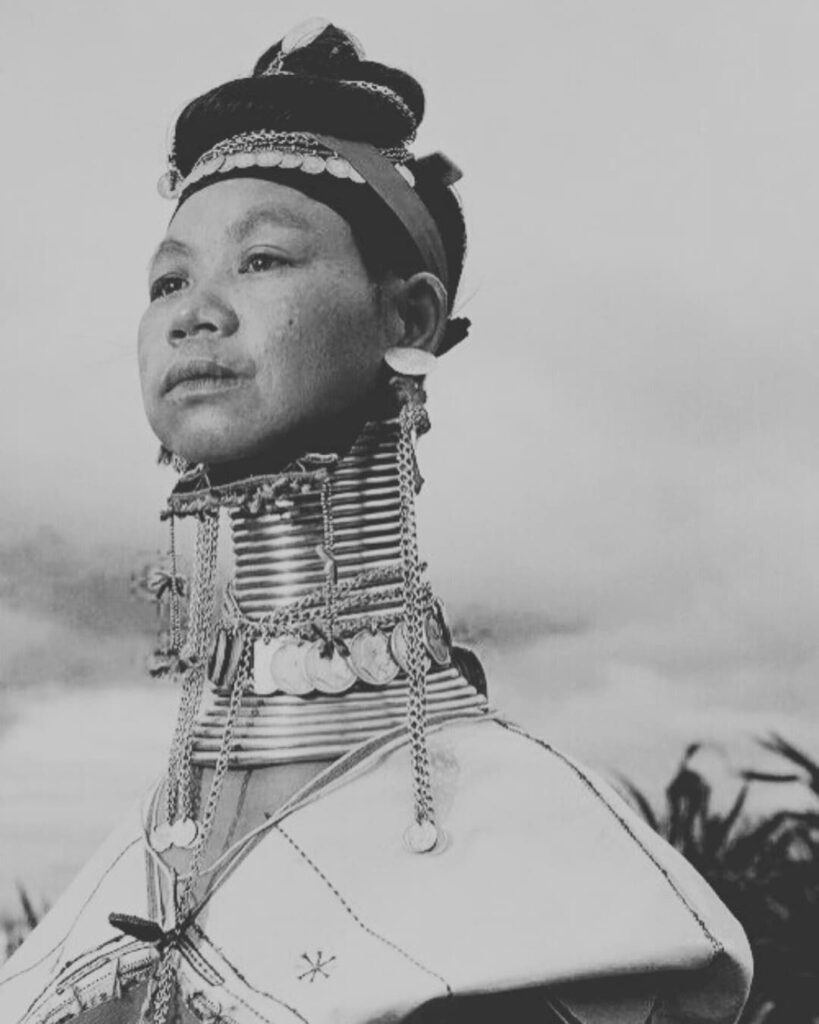
The Kayan (Padaung) Women
The Kayan are often encountered in discussions of the wider Karen context, although they are a distinct people. They are particularly known for the brass coils worn by some Kayan women, a practice that has become one of the most recognisable images associated with Northern Thailand. Women start wearing neck rings from as early as 2 years old, with a ring or two added each year. By the time they are in their 20’s, the rings can weigh as much as 25 pounds.
The image has become complicated by tourism. A cultural practice can become spectacle remarkably quickly when removed from the people who give it meaning.
This is where looking becomes important. To see a woman wearing brass coils is one thing. To ask what the practice means, who wears them, how it has changed overtime, and how the women themselves understand it is another.
The difference is attention.


The Hmong People
The Hmong have lived across the mountains of southern China and mainland Southeast Asia for centuries, with communities today found across China, Vietnam, Laos, Thailand and further afield.
Their history is one of displacement and migration. Wars came and villages were abandoned. Families travelled through mountains and across countries, carrying with them only what could be carried.
Among the things they carried was cloth.
Hmong textile traditions are among the most distinctive in Southeast Asia, particularly the intricate embroidery, appliqué and reverse appliqué known collectively in many contexts as paj ntaub, or “flower cloth.”
At first, the colours catch the eye. Then the detail. Then the patience required to make it.
Patterns are built stitch by stitch, with techniques and visual traditions passed through generations. Clothing becomes a place where identity can be made visible: in colour, construction, motif and the way a garment is worn.
But the Hmong relationship with textile goes further than dress.
In the twentieth century, Hmong women began creating pictorial textiles that came to be known as story cloths. Through embroidered figures, animals, landscapes and scenes arranged across the surface, these works could tell stories of Hmong life, legend, war and migration. Some can be read sequentially, moving across the cloth almost as one would move through the pages of a book.
The needle became a way of recording what could not easily be written elsewhere.
There is something deeply moving about this transformation. Perhaps this is why Hmong textile work feels so alive. It is not simply concerned with making something beautiful. It has provided a way of carrying identity through extraordinary change.
With The Hmong we are reminded that when people move, culture does not necessarily remain behind.


The Lisu People
The Lisu live across the highlands of southwestern China, Myanmar, Thailand and neighbouring regions. Their historical homeland lies around the upper Mekong and Salween, within the wider Tibeto-Burman cultural and linguistic world.
In Northern Thailand, they are difficult to miss.
Colour arrives first.
Blue. Red. Green. Purple. Pink. Yellow.
Lisu clothing is among the most vivid in the region, particularly among the striped Lisu communities of Thailand. Women wear brightly coloured garments decorated with bands of cloth, beads and silver, while elaborate shoulder bags are worn as part of everyday dress and ceremonial life.
Their bags are particularly beautiful.
Some are embroidered with small square panels at the corners, each carrying its own pattern. The designs are not necessarily repeated exactly from one maker to another. The work of the hand remains visible.
A signature, made in thread.
But colour is only the surface.
Beneath it is another way of remembering.
Lisu history has traditionally been carried through song. Genealogies, stories and knowledge have been passed orally from one generation to the next, with some songs lasting for hours and, in some traditions, an entire night.
There is something extraordinary about this.
A written history can be placed on a shelf.
A sung history must live somewhere else.
In the body.
In the voice.
In memory.
The singer becomes the archive.
And perhaps this helps explain something about the importance of performance within Lisu life. Knowledge was not necessarily something separate from living. It was something practised, spoken, remembered and repeated until it became part of the person carrying it.
Traditional Lisu spirituality likewise developed through close relationships with ancestors, spirits and the natural world, with ritual specialists playing important roles in some communities. Traditional villages could contain sacred spaces associated with powerful spirits, including beliefs concerning a sky spirit. Religious life has changed considerably across different Lisu communities, particularly through the influence of Christianity, and there is no single contemporary Lisu religious practice.


The Lahu People
The Lahu are a highland people whose communities today extend across southwestern China, Myanmar, Laos and Thailand. They are part of the wider Tibeto-Burman cultural and linguistic world, with historical roots associated with the mountainous regions of Yunnan and neighbouring areas.
Over generations, Lahu communities moved southward through the highlands of mainland Southeast Asia, eventually establishing villages across the mountains of Myanmar, Laos and Northern Thailand.
The journey matters.
The Lahu did not arrive in the Golden Triangle as an isolated people suddenly appearing on a modern map. Their presence belongs to a much older history of movement through the mountains, before the borders between China, Myanmar, Laos and Thailand divided the region into separate countries.
Today, several Lahu communities live across the Golden Triangle, including Black, Yellow, Red and White Lahu. Their clothing, language and customs differ between groups, but they share a broader cultural inheritance shaped by life in the highlands.
Lahu communities have traditionally practised forms of shifting cultivation adapted to mountainous environments, growing crops including rice and maize alongside other plants.
The phrase “slash and burn” is often used to describe these agricultural systems, but the phrase tells us very little about the knowledge involved.
To cultivate a mountain requires attention.
Where to plant.
When to clear.
Which crops will grow.
When the soil needs to rest.
It is an agricultural system that depends upon understanding change rather than trying to eliminate it.
The landscape is not static.
Neither is cultivation.
The farmer learns to work with cycles of growth, use and regeneration.
This knowledge is practical, but it is also cultural. It belongs to generations of people who have learned to read the particular conditions of their environment.
The mountain becomes a teacher.
This attentiveness to the landscape extends into traditional Lahu spiritual life.
Traditional Lahu cosmology includes Geusha, understood in many accounts as a creator or supreme deity, alongside relationships with spirits associated with ancestors, places, natural phenomena and everyday life. Ritual specialists have historically played important roles in maintaining relationships between people and the spiritual world.
The distinction between the visible and invisible was therefore not necessarily absolute.
A forest could house spirits.
An ancestor could remain part of the life of the living.
The sky was not simply something above the village.
It belonged to the same world.
This worldview helps us understand why the landscape cannot easily be separated from Lahu life. The forest is a source of food and material, but it can also be a place of spiritual presence. The field provides nourishment, but it is also part of a larger relationship between people, land and season.
The practical and the sacred are not always separate rooms.
The Lahu people also have rich traditions of musical expression, including flutes, mouth organs and other instruments. Music accompanies communal gatherings, courtship, ceremonies and ordinary social life.
The naw, a traditional mouth organ, is particularly associated with Lahu musical culture.
What interests me is that music does not appear to exist only for performance, it is infact another way of inhabiting the community.
Some cultures preserve knowledge in books, and the Lahu people carry knowledge through sound.


The Golden Triangle is often described through geography and geopolitics: three countries meeting at a point, a region marked by trade, conflict and a complicated modern history.
But the mountains existed before the borders.
People moved through them long before maps divided them.
The Akha, Mien, Karen, Hmong, Lisu and Lahu are not variations of one story. Each has its own history, language, beliefs and ways of making a life. To place them together is not to make them the same, but to notice the geography they have shared: a mountainous world through which people, materials, ideas and traditions have travelled for generations.
Perhaps this is why I still think about them.
Not because they represent some untouched past. They do not.
These are living communities, changing as all communities do, negotiating modernity, migration, religion, economics and the pressures of a rapidly changing world.
What deserves our attention is not the idea of preserving them in some imagined state of timelessness.
It is the knowledge they continue to carry.


