
Words: Khumoetsile Seamogano
Images: A broad spectrum of Girl Gone Authentic
archives: books, scholarly articles, photographers
and memory.
The mud architecture of Mali has, by centuries, outlived the Mali Empire.
Between approximately 1230 and 1670, the Mali Empire, or Manden Kurufaba, became one of the largest and wealthiest empires in West Africa. Its territory extended across parts of present-day Mali, Mauritania, Senegal, Burkina Faso and Niger. Its most famous ruler, Mansa Musa, became almost synonymous with the empire’s extraordinary wealth, particularly its gold. Today, Mali remains one of Africa’s major gold producers, yet much of the country’s population continues to live with significant economic hardship, the contrast of then and now is hard to ignore and the questions can build mountains.
For now, let us shift our attention to what prevails: Mali’s earthen architecture; a living building tradition sustained through material knowledge, seasonal repair and the continued participation of the communities who inhabit it.
Djenne, A City of Mud and Great Buildings
Situated near the confluence of the Niger and Bani rivers, Djenné developed as an important centre of trade and Islamic scholarship. Its historic town contains more than 2,000 traditional earthen houses, many constructed from banco, a locally produced earthen building material. The material gives the city its distinctive architectural language: substantial walls, softened corners, recessed openings and projecting timber elements. The buildings appear almost sculptural, but their forms are closely tied to the demands of climate and availability of local materials.
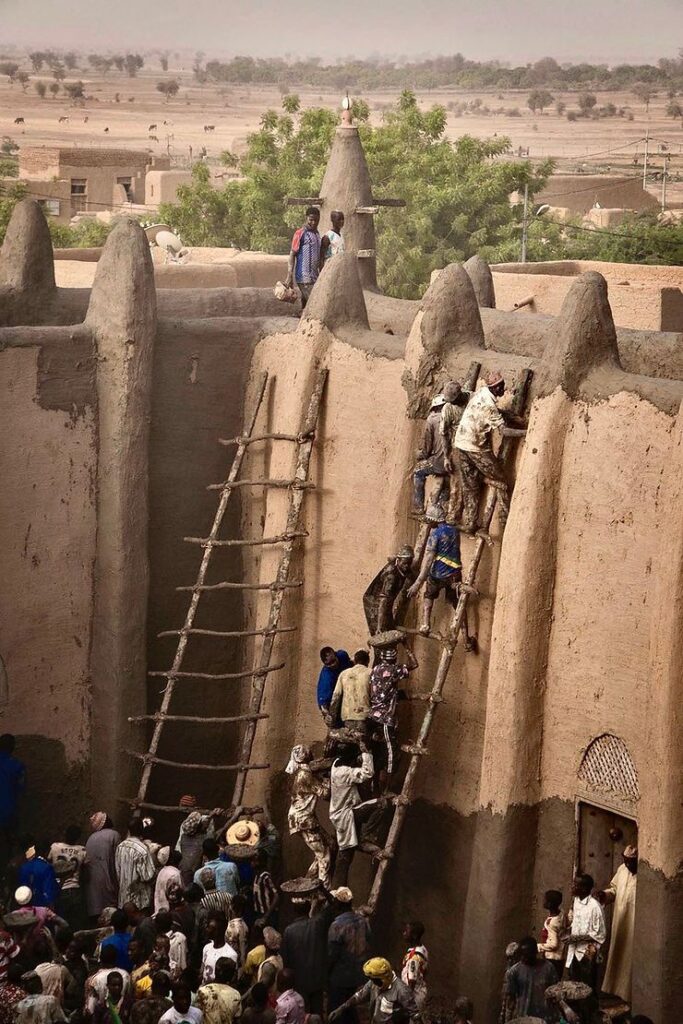
At the centre of the city stands the Great Mosque of Djenné. The present structure was completed in 1907, on the site of earlier mosques and within a much older tradition of earthen construction. Its walls are built from banco and reinforced with timber beams that extend through the façades. The beams are structural, but they are also a scaffolding. During the annual replastering, workers use them as footholds to climb the façade and renew the earthen surface. The architectural design anticipated and incorporated a means of maintenance to transcend the times.

Built in 1907, the Great Mosque of Djenne is considered one of the greatest achievements of the Sudano-Sahelian architectural style. The building is made from mud and repaired every May during the Festival of Plastering.

The wooden beams not only add a uniqueness to the building, they also serve as steps the men use to go up and down the building during repair.

The terracotta covers the vents on the roof of the mosque to provide proper air ventilation.

The Architecture of Repair
Each year, the Great Mosque is replastered during the Festival of Plastering, La Fête de la Créppissage.
The work is communal.
Men bring and apply the mud. Women traditionally carry water and prepare food. There is music. What might elsewhere be understood as routine maintenance is a civic event. The mosque’s longevity depends on continued use, continued knowledge and continued labour, that also gathers and strengths the community through inherited traditions of repair and building. Its permanence is not the permanence of its material, but rather the continuity of the practice that renews it.
This is also why the masons of Djenné matter. Their knowledge encompasses more than a construction technique as it includes an understanding of the earth itself: its preparation, consistency, drying, application and behaviour under the particular conditions of the Sahel. One Djenné mason, Boubacar Kouroumansé, described the city simply:
“Djenné is my school.”
The phrase is an unusually concise description of vernacular architectural knowledge. The city is not merely where the craft is practiced. It is where the craft is learned, lived and passed on.
Material and Climate
Earthen construction is particularly suited to the environmental conditions of the Sahel. Its substantial walls provide thermal mass, slowing the transfer of heat between exterior and interior. Openings, courtyards and orientation create ventilation and shade. Through material, proportion, orientation and continual maintenance, these buildings respond precisely to their climate. Architecture, in this sense, does not isolate itself from its environment. It enters into a relationship with it. The building and the climate become part of the same system: a cocreation and a merging of intelligences.
This is where the distinction between vernacular architecture and contemporary “sustainable architecture” becomes interesting.
The buildings of Djenné were not conceived within the vocabulary of sustainability as we understand it today. They emerged from a vocabulary of necessity, place and accumulated knowledge. Local materials were readily available; imported materials were expensive or inaccessible. The climate imposed its conditions, and people learned to build accordingly. What we now describe as sustainable design was, in many places, simply the intelligence of building well within the conditions of a particular place.
There is something worth remembering here. Sustainability does not always begin with a new technology or a new material. Sometimes it begins with paying attention to the sun, the wind, what the earth provides, and to what a place is already telling us.
Architecture does not have to overcome an environment, it must learn to live within it.


Beyond Djene
The same relationship between material, landscape and social organisation appears differently among the Dogon communities of central Mali.
The Bandiagara Escarpment provided a dramatic geological setting for settlement, and Dogon architecture developed in response to the cliffs, plateaus and surrounding landscape. Here, architecture negotiates with the land. Settlements follow the natural topography, while earthen structures extend across and into the rocky environment.
Among the most recognisable are the granaries, built to protect grain and other possessions. Their distinctive forms are practical, but their meaning extends beyond storage. Some traditional granaries were associated specifically with women and used to keep their personal possessions separately from those of their husbands. The granary is therefore both an object of utility and a piece of social architecture. It gives physical form to ideas about possession, privacy and independence. What is stored, where it is stored, and who it belongs to are not incidental details. They are written into the architecture itself.
This is perhaps what makes vernacular architecture so revealing. A building does more than answer the practical demands of its environment. It records the relationships of the people who inhabit it along with their economies, their hierarchies, their rituals and their ideas about what must be protected.
In this sense, architecture becomes a kind of social memory.The landscape shapes the building. The building, in turn, gives shape to the life within it.

Dogon ritual. The religious beliefs of the Dogon are enormously complex and knowledge of them varies greatly within Dogon society. Dogon religion is defined primarily through the worship of the ancestors and the spirits whom they encountered as they slowly migrated from their obscure ancestral homelands to the Bandiagara cliffs

The cliffs are lined with vertical faces of earthen houses that seem impenetrable. Over the years, the Dogon people developed stamina as well as techniques to effectively and efficiently maneuver through their home. A skill that would take a stranger years to perfect.

A typical Dogon village is dotted with granaries made from mud, a sophisticated invention that to this day is still in full use. The more granaries with pointer ‘hats’, the wealthier the homestead is considered to to be.

‘Female’ granary
The Dogon females are usually independent, a granary like the one above, usually holds a females belongings, separate from her husband’s.

A mosque in the Dogon region.
Should we look to Mali’s time honed architecture for sustainable alternatives?
It would be easy to turn Mali’s earthen architecture into an argument for “going back to basics.” That is not particularly useful. The point is not that contemporary architects should abandon concrete and begin building everything from mud. The more interesting question is what this architecture asks us to reconsider.
What if durability includes maintenance rather than simply resistance to deterioration?
What if a building is designed around its repair cycle from the beginning?
What if local material knowledge is treated as architectural intelligence rather than as a remnant of the past?
The Great Mosque of Djenné offers an unusually clear answer to the question of permanence. It does not endure because its material is permanent. It endures because the knowledge required to renew it has remained alive. From the beginning it understood that change was inevitable.


